Showing posts with label King Ranch-Cheyenne. Show all posts

Wednesday, April 25, 2012

The First Registered Stallion

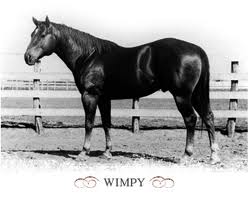
     Wimpy P-1, born Wimpy, was foaled on the King Ranch in the Spring of 1935. Sired by Solis, a direct stallion sired by Old Sorrel, the King Ranch’s foundation stallion Wimpy would become one of the most known horses in the American Quarter Horse Association (AQHA). Solis’ dam was an unregistered and unnamed mare of Thoroughbred breeding who was by Right Royal and out of a mare by Martin’s Best. Wimpy’s dam was a mare named Panda, also sired by Old Sorrel. Panda’s dam was a roan mare by Hickory Bill. Wimpy came be traced three times to Hickory Bill, making him quite inbred to Hickory Bill.
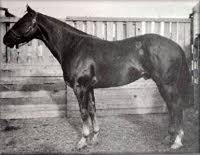
 
     Wimpy was a chestnut colored stallion, with a star and a sock on his left hind leg. When fully grown he was 15 hands high and weighed about 1200 pounds. Horse’s height is measured in hands that equal 4 inches.

     When the AQHA was founded in 1940, the founders agreed that the Grand Champion Stallion of the 1941 Fort Worth Southwestern Exposition Quarter Horse Show would be recorded as number one sire in their stud book.
Kleberg decided Wimpy was more than adequately equipped to handle the position.

      In the arena were Judge Jim Minnick, ring steward Robert Denhardt and John Burns, president of the show. Preceding Wimpy was Silvertone, a palomino owned and shown by Lee Underwood; Little Joe Jr., by Joe Gonzales; and Silver Dawn, bred by the Waggoner Ranch. Each contestant entered the ring and began circling the arena. Once satisfied Minnick stopped the horses to get a closer look and then continued their walking. After extensive consideration, the blue ribbon went to Wimpy and with it P-1 in the stud book.

    In his lifetime Wimpy would sire 174 registered foals, the majority of which stayed on the King Ranch. However, the few that left the ranch left a lasting impact in the horse industry. The stallion produced sons and daughters that went onto produce AQHA Champions. His direct offspring includes Bill Cody, Kip Mac,Caballero, Wimpy’s Image, Silver Wimpy, Wimpy II, Lauro and Showdown.

     In 1958, Bob Kleberg gifted Wimpy to George Clegg, the original breeder of Old Sorrel. Unfortunetly, Clegg fell on hard times and sold Wimpy to oilman Rex Cauble. Wimpy sired a few foals for Cauble before his death on August 13, 1959 at 22 years of age. 


     Wimpy was inducted into the AQHA Hall of Fame in 1989. A bronze statue was erected of the famous horse outside the AQHA Headquarters in Amarillo, Texas.  


Resources:


The Running “W” Horses Are Born

     The Running “W” brand is adorned by some of the most famous Quarter Horses in history. The king ranch, initially built to raise cattle began raising horses because the founder, Richard King, knew to raise the best cattle one must have the best horses. This led to one of the most notable and famous horse breeding programs in the United States. 


      In the 1800s, the Quarter Horse made its debut on Texas ranges. While racing was a large event in Texas from 1850 to 1940, Jared Lee, an associate of King Ranch stated that the ranch did not race their Quarter Horses, “they are used for ranch work, what there were originally bred to do for Captain King.”
Although Texas is now a permanent home for Quarter Horses, the land was not always so welcoming. For instance, Captain King bought his ranch near the Santa Gertrudis Creek where a large amount of wild mustang and cattle were already grazing. While King gathered the cattle he let the mustangs be, buying horses from the Mexican towns of Mier and Camargo. The wild horses remained untouched until Robert J. Kleberg, Sr. was in control of the ranch. He trapped the wild herd and traded them for better bred horses from Tennessee to Mississippi.
     On August 3, 1854, King purchased an American stallion for $250 and an American bay for $300. A few months later he spent $600 on a sorel stallion named Whirlpool. Later on King purchased several more stallions from a farm in Kentucky, paying between $300 and $1,000. These purchases were large at the time, especially when compared to the $300 spent on purchasing the ranch as a whole.
Once on the ranch, King meticulously picked out broodmares for his new stallions focusing on foundation, size and color. From 1885 to 1910, King Ranch became one of the leading producers of horses and mules.
Following King’s death in 1885, Robert Kleberg, Sr., took over the horse program in particular. Originally seen merely as a lawyer and tenderfoot, his knowledge of the Quarter Horse, cattle and the business earned the ranch hands respect. After Robert Kleberg, Sr. came his son, Robert (Bob) Kleberg, Jr.. His active role in the Quarter Horse breeding program shows what extrodinary accomplishments King Ranch achieved. Throughout his years on the ranch, Kleberg’s education in genetics enabled him to succeed in improving the quality of the cattle and Quarter Horses.
     The horse that became the foundation sire of all the King Ranch’s Quarter Horses was known as Old Sorrel. Kleberg, Jr. came across Old Sorrel who, even at such a young age displayed all the qauliteis he was looking for in Quarter Horses. The colt, as well as its mother, was bought for $125 and brought to the ranch. He obtained all of the necessary training of a Running “W” colt such as habituateing himself to the boiling tempatures, the dust and unfriendly landscape. Kleberg, Jr. reffered to him as “the best cow horse (he) ever rod, but also a damn good running horse. He had a well-balanced look and the feel of a race horse.”
     
     Due to selective sorting based on which mares would do Old Sorrel justice in breeding, the mares were the best at King Ranch between 1927 and 1937. Until his death at 31, Old Sorrel remained on the King Ranch. By 1993, most of the Quarter Horses of King Ranch had 90% Old Sorrel lineage from one or both parents.
The ranch went on to produce the number one registry in the American Quarter Horse Assocaition, Wimpy P-1. 
As well as Wimpy P-1, the King Ranch produced other well-known champions such as Mr. San Peppy, Peppy San Badger (Little Peppy), both earning the National Cutting Horse Assocation world champion title in 1974 and 1976.


      Bold Venture, the 1936 Kentucky Derby and Preakness Stakes winner, was added to the breeding program in 1939 and became the only horse to sire two Kentucky Derby winners, both out of King Ranch mares. Middleground, also sired by Bold Venture, won the 1950 Kentucky Derby and Belmont Stakes. In 1946, Assult became the seventh Triple Crown champion in turf history and the only Texas bred horse, to date, to win the Triple Crown. Assault was the greatest of the King Ranch’s major stakes winners, completing a racing career that brought eighteen victories and total earnings of $674,720. Assault retired in 1948 for a short time but due to being an unsuccessful breeder ran a few more races until he was retired in 1950 for the last time. Assault died at the age of 28.


La MaDama; A Queen Named King


     Henrietta King did not become the “Queen of King Ranch” simply by taking the name of it’s founder, Richard King. For 40 years Mrs. King was the sole owner of the largest ranch in North America, presiding with both moral authority and business intelligence.
Henrietta King, 53
     After her husband’s death Mrs. King, at the age of 53, took over the 614,000 acre ranch and its debt. She continued her work with the health care and education of the Mexican ranch hands and in the process adopted many of their folkways and language. True to her Presbyterian heritage, Mrs. King forbade drinking, swearing and card-playing among the ranch hands. With her son-in-law, previous family lawyer, Robert J. Kleberg, as her co-manager, she eliminated the $500,000 debt left her by her late husband and expanded the ranch’s holding to more than one million acres. Under her guidance, she not only doubled the ranch in size but also promoted the ranched engagement in experiments in cattle and horse breeding, in range grasses and in dry and irrigated farming. The ranch continued to grow reaching a size of 1,173,000 acres by 1925.
Original home built by Richard King for his bride. Burned in 1912
     In 1912, the main house built for her by her late husband in 1856, burned to the ground taking with it the family keepsakes. No one was reportedly harmed in the fire and while the cause is unconfirmed, it is said a disgruntled gardener started the catastrophe. Mrs. King requested a fireproof house that would be elegant, yet comfortable enough for a man in boots. The result was the 25-room “Big House” patterned after a Mexican hacienda. 

"Fire Proof" home built at the request of Mrs. King

     Mrs. King later constructed a mansion on the bluff in Corpus Christi so that her daughter Alice’s children could attend school. Mrs. King took interest in the growth of settlement in the region between Corpus Christi and Brownsville. Around 1903 she offered 75,000 acres at the right-of-way to Uriah Lott and Benjamin Franklin Yoakum, who planned to construct the St. Louis, Brownsville and Mexico Railway. In 1904 she furnished town sites for Kingsville and Raymondville. She founded the Kleberg Town and Improvement company and the Kingsville Lumbar Company to sell land and materials to new settlers. As the town grew she invested in the Kingsville Ice and Milling Company, Kingsville Publishing Company and Kingsville Power Company. Mrs. King also invested in the Gulf Coast Gin Company and the Kingsville Cotton Oil Mill Company. She constructed the First Presbyterian Church in the town and also donated land for Baptist, Methodist, Episcopal and Catholic churches. She promoted schooling by constructing a public high school for the town of Kingsville. Among her other charities were donations of land for the Texas-Mexican Industrial Institute and the Sophn Sanitarium. Later in life she provided land for the now Texas A&I University.
Henrietta King, 91
     Mrs. King passed away on March 31, 1925 at the age of 92. She died at the ranch where she had stayed for seven decades. Before her death 5,000 family, friends, and workers came to her bedside to pay their respects and say their goodbyes. Some of the ranch hands rode for two days straight to attend her funeral. At the lowering of her casket some 200 ranch hands rode quarter horses adorning the running “W” brand round her grave, hats held aloft, to pay their respects.
Henrietta had controlled the ranch 8 more years than her husband being the owner for 40 years compared to his 32.
     Since her death, Mrs. King has had several books written in her honor and become a well known face of Texas ranching. In 2002, Henrietta King, along with 158 other honorees was inducted into The National Cowgirl Museum and Hall of Fame.


Henrietta Maria Mose Chamberlain King


     Born to Presbyterian preacher Hiram Chamberlain and his wife Maria (Morse) in 1832, Henrietta Marie Morse Chamberlain was thought to follow the family pattern and marry a minister. Instead she married a boat captain and speculator with little education known as Richard King. 

Henrietta Maria Mose Chamberlain King
     
After her mother’s death in 1835, Mrs. King grew up lonely but self-reliant. At the age of 14 she attended the Female Institute of Holly Springs, Mississippi for two years. Upon leaving the school she moved to Brownsville with her father where she would meet Mr. King.
     The couple met in 1850 when King came across the Chamberlain's house boat in what he thought to be his reserved loading dock. It is said that King then let loose a volley of curse words at the residents until 17-year-old Henrietta stepped on deck and reprimanded him. King fell in love with her from the start and in December of 1854, Reverend Chamberlain officiated at his daughter's marriage to Richard King. But Henrietta did not become the Queen of the King Ranch simply by taking Richard's last name.
King brought his bride to inhabit his newly claimed tract on Wild Horse Prairie. While their honeymoon was a dusty and treacherous journey across the dangerous and disputed territory, Mrs. King is quoted as describing it in a grandeous way.
Richard King

“I doubt if it falls to the lot of any bride to have so happy a honeymoon. On horseback, we roamed the broad prairies. When I grew tired, my husband would spread a Mexican blanket for me, and then I would take my siesta under the shade of a mesquite tree.” -Henrietta Chamberlain King
   
  Their first home was a mud-and-stick jackal so small that they hung their cooking pots outside the door. Wild Horse Prairie in that era was dangerous and disputed territory. On one occasion Henriette saved her sleeping child from a tomahawk baring Native American. She bargained with him and the man left with a loaf of bread and no disputes.
     The ranch had few buildings, and Mrs. King learned to live without even the small comforts of a border city. The Kings kept a house in Brownsville where their first children were born, but Henrietta had come to love the ranch and returned as frequently as possible. The first permanent home was built on the ranch in 1858. This house would be destroyed by fire in 1912 and lead way for the construction of the “Big House”.
Richard King, 1883
During the Civil War, King was involved in smuggling Confederate cotton to Mexico. When Union troops came to retrieve him, King fled leaving a Mexican man to protect his family. The troops raided the house before Henrietta's eyes. Soon thereafter she moved her children and herself to San Patricio and then San Antonio. King joined the Confederate Army and upon his return presented Mrs. King with a pair of diamond earrings that she would wear the rest of her life. 
     The ranch prospered in the years of the cattle drives, but upon the death of their only son, Robert E. Lee King, to pneumonia in 1883, King began considering to sell the land and give up. When Mrs. King heard this she reminded him of General Robert E. Lee;s words to “never sell”.
Richard King would never live to see the true accomplishments of the ranch due to his death of stomach cancer only two years later in 1885, leaving 53 year old Henrietta 614,000 acres and $500,000 in debts.
For the rest of her life Henrietta adorned black. For her remaining days, Mrs. King wore only black gloves, bonnets, gowns and her diamond earrings mourning her lost soul mate.